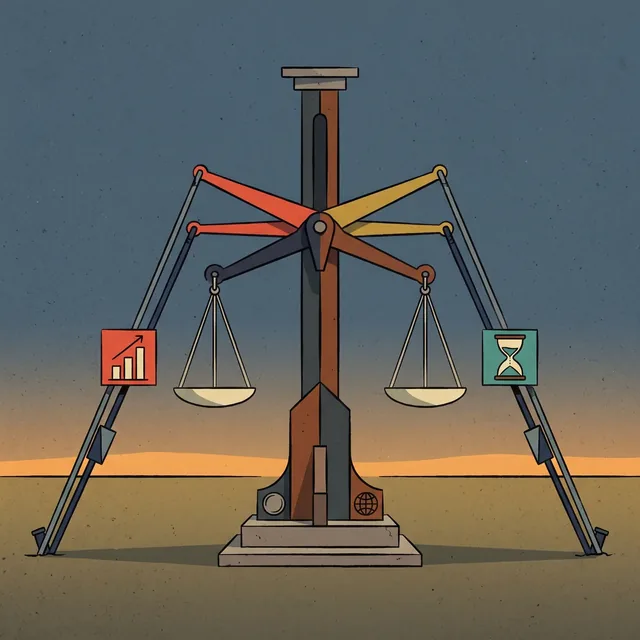
Complex systems often rely on indirect pressure rather than direct force to alter trajectories. By introducing targeted friction, decision-makers attempt to shape the choices available to external actors.
This dynamic is visible in how states manage international disputes. CNN reported that the U.S. Senate and House of Representatives approved sanctions aimed at discouraging Iran's development of nuclear weapons. CNN reported that Obama signed into law new U.S. sanctions on Iran.
How Structural Constraints Shape Behavior
Using legislation to discourage specific state-level development programs highlights a reliance on structural constraints. Instead of addressing a conflict through immediate physical means, this approach attempts to alter the underlying economic environment. The goal may be to make a specific objective so resource-intensive that pursuing it becomes structurally unviable.
One reading is that sanctions like these may be part of an iterative strategy. In complex negotiations, advantage is rarely established in a single motion. It is often built incrementally, layering constraints until the cost-benefit calculation of the opposing party begins to shift. This method requires patience and a tolerance for prolonged, systemic tension.
Why Indirect Pressure Replaces Direct Control
For strategists and system architects, the underlying principle extends beyond international relations. When direct control over an outcome is impossible, the most effective alternative may be designing an environment where the undesired action becomes increasingly difficult to sustain.
A system of escalating constraints operates on the premise that actors will eventually adjust their behavior to avoid continuous friction. Whether applied to global policy or organizational design, the mechanism remains similar: shaping the environment shapes the outcome.
True influence might not require absolute authority, but rather the capacity to systematically raise the cost of an opponent's preferred path.