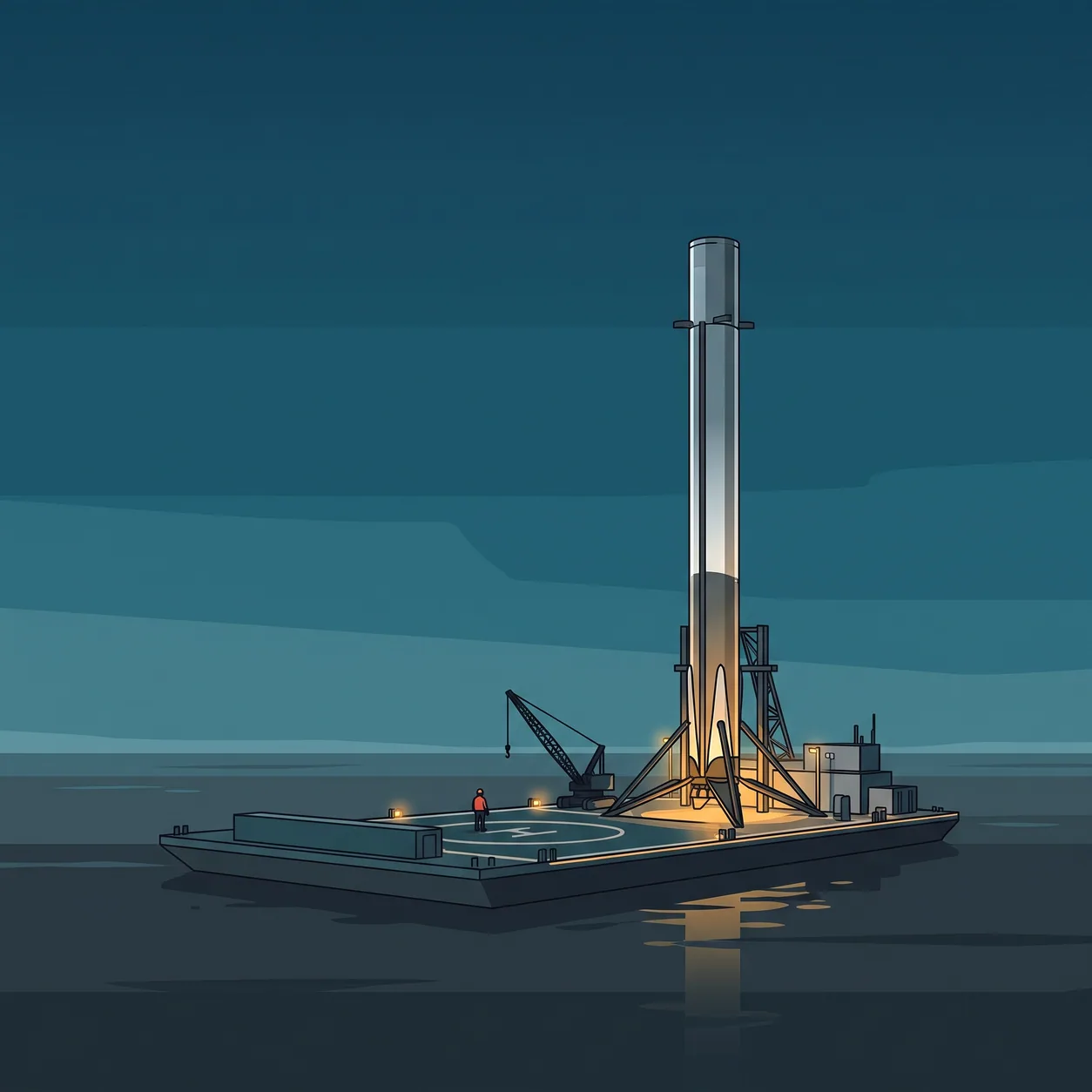
Building complex engineering systems can often require multi-year iteration cycles before key operational recovery milestones might finally be achieved. Demonstrating hardware reusability may demand both technical precision and sustained procurement support across long timelines. Wikipedia's current-events log for November 13, 2025, recorded that in the United States, Blue Origin launched NASA's ESCAPADE spacecraft mission to study Mars' magnetosphere. Wikipedia's log added that the launch was the second launch of Blue Origin's New Glenn launch vehicle, and the first successful landing of the vehicle's reusable first stage.
According to a release by Blue Origin, NASA's Launch Services Program awarded Blue Origin's New Glenn the Escape and Plasma Acceleration and Dynamics Explorers (ESCAPADE) contract. In an earlier announcement of the launch contract, Blue Origin stated that ESCAPADE is a dual spacecraft mission under the NASA Small Innovative Missions for Planetary Exploration (SIMPLEx) program to study Mars' magnetosphere. Blue Origin stated that Blue Origin was on-ramped to the NASA VADR launch services Indefinite Delivery Indefinite Quantity (IDIQ) contract on January 26, 2022.
How Reusability Might Transform High-Stakes Systems
Establishing stage recovery in high-capacity hardware might offer useful structural lessons for modern infrastructure planning. When primary components are successfully retrieved, engineering teams might gradually unlock lower marginal operating costs alongside accelerated mission cadences. In general, demonstrating reliable asset retrieval could shift organizational priorities away from disposable prototypes and toward enduring operational platforms. Such technical milestones may suggest that complex physical systems can evolve from high-risk experiments into predictable, reusable utility networks.
Why Patience and Procurement Alignment Can Drive Execution
For builders operating within capital-intensive domains, early recovery achievements might highlight the essential role of long-term contract structures. Public-private partnerships and flexible procurement mechanisms might provide the multi-year stability that complex hardware development may require. When institutional backing aligns with iterative testing protocols, technical teams may gain the necessary bandwidth to attempt ambitious engineering recoveries. Perhaps sustained progress in deep-tech projects might rely as much on continuous institutional frameworks as it can on immediate engineering breakthroughs.
Systemic resilience might ultimately depend on verifying that high-value machinery can survive demanding operational conditions to perform future tasks. Achieving recovery during a major operational attempt could signal a vital transition toward circular technical ecosystems.
Validating asset reusability could perhaps help turn ambitious technical concepts into reliable operational standard practices.
Sources
- Portal:Current events/2025 November 13 (revision 1322687952) - Wikipedia, 2025-11-17-11-17
- NASA Awards Mars Science Mission Launch to Blue Origin’s New Glenn | Blue Origin - Blue Origin, 2023-02-09