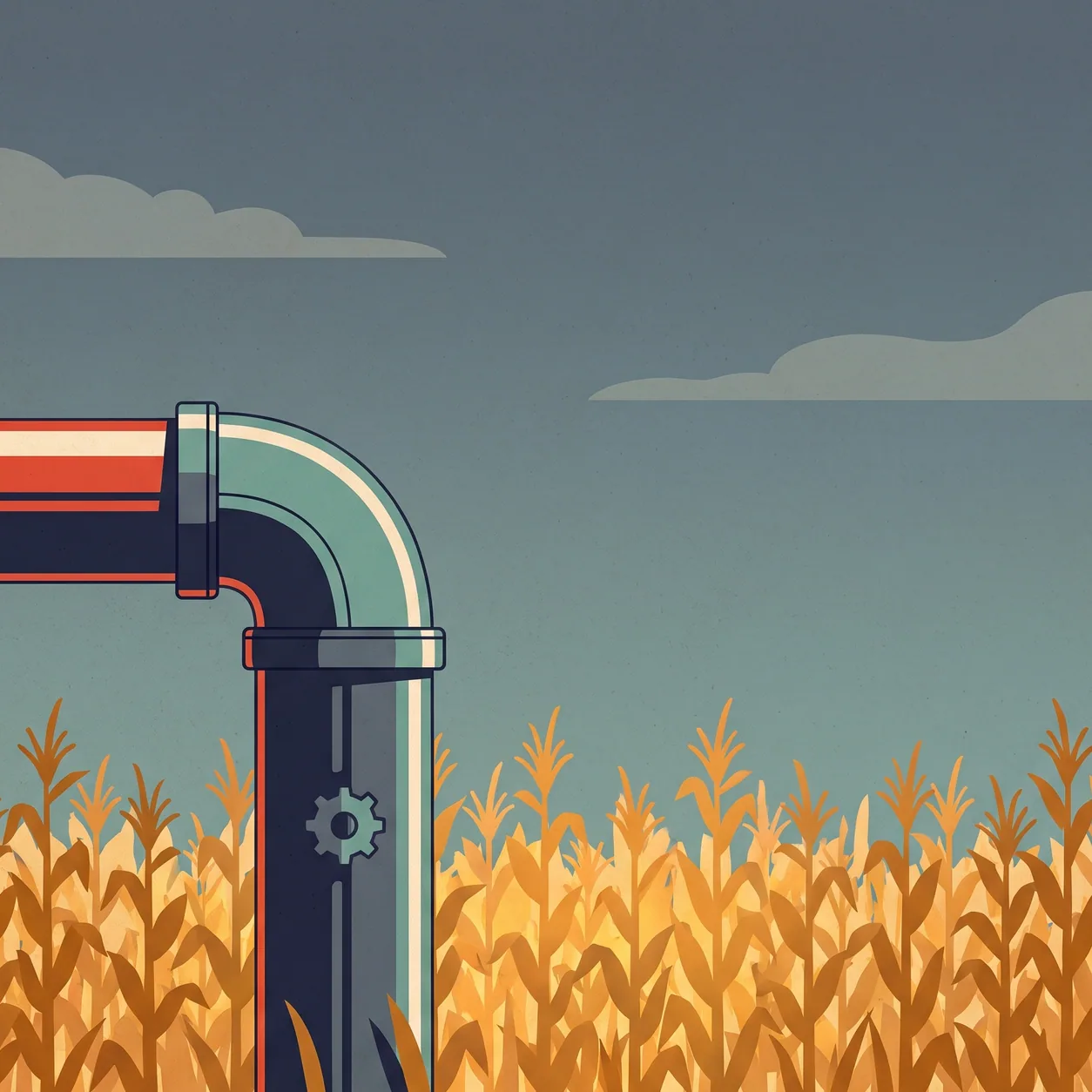
Agricultural innovation often focuses on yield, pest resistance, or nutritional value. But treating a plant as a specialized industrial component shifts the fundamental purpose of a crop from sustenance to manufacturing. When biological systems are optimized for industrial extraction, farming infrastructure effectively becomes an extension of the factory floor.
Wikipedia's current-events log for February 11, 2011, recorded that the U.S. Department of Agriculture says it has deregulated a genetically engineered corn.
This type of modification suggests a different approach to biological systems. Instead of adapting a standard food product for secondary industrial uses, the organism itself is optimized at the genetic level for a specific downstream process. Designing a plant strictly for fuel production might alter how agricultural supply chains are structured, separating food-grade commodities from industrial-grade biomass at the genetic source. Such specialization could streamline the refining process, potentially reducing the time and energy required to convert raw plant matter into usable fuel.
Redefining Biological Outputs
Viewing a crop as a dedicated input for energy production may change the economic calculations of land use. If a plant is engineered strictly for industrial extraction, the fields where it grows operate more like open-air refineries. This approach could encourage builders, investors, and policymakers to evaluate biological engineering not just as a tool for food security, but as a foundational platform for materials science and energy infrastructure.
Applying product-thinking principles to agriculture means defining the end user and the desired output before the seed is even planted. A crop designed for ethanol may require different handling, processing, and storage than one destined for human or animal consumption. Managing these parallel systems might require new logistical frameworks to ensure specialized industrial crops remain distinct from the food supply. This level of specialization suggests that future agricultural networks might operate as highly segmented pipelines, each tailored to a specific industrial or nutritional end goal.
When biology is treated as a programmable manufacturing input, the boundary between agriculture and heavy industry begins to blur.
Sources
- Portal:Current events/2011 February 11 (revision 414463490) - Wikipedia, 2011-02-17